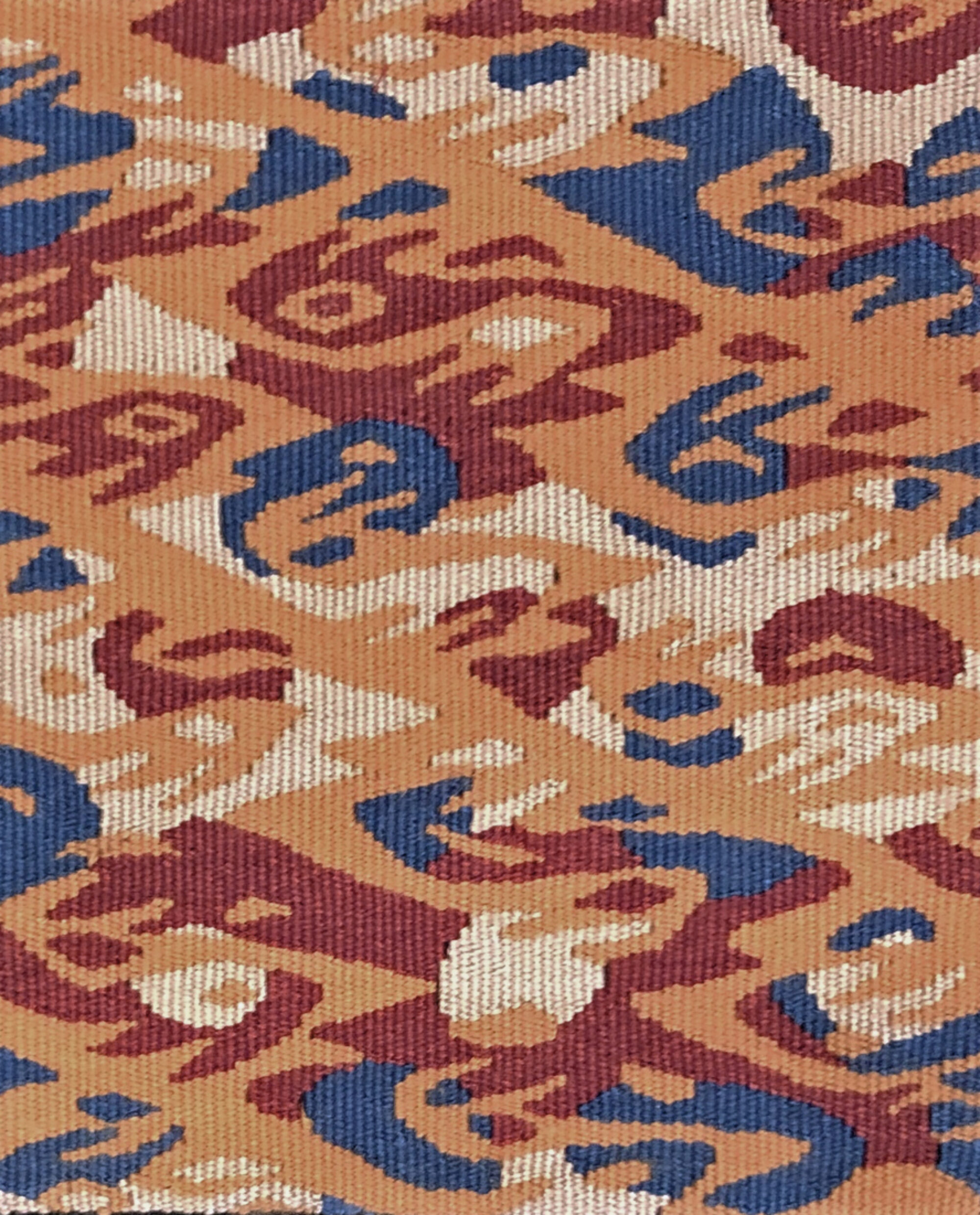

The Coptic period in Egypt begins in the late 3rd C CE, under the influence of late Roman art, and develops fully during the Byzantine Period (323-642 CE). By that time Christianity was integrated into Egyptian society and consequently Coptic art is usually considered to be Christian art. After the Arab conquest of Egypt in 640, evidence of Coptic culture is restricted to earlier Nilotic, Classical and Christian features that have been incorporated into Islamic art.
Square with a Nereid, 7th C CE, 23.5 x 23.2 cm. Rutschowscaya 72.
The term Coptic is derived from a Greek word meaning Egyptian. It was used by the conquering Arabs to refer to native Egyptians, who for many years had been subject to the rule of other cultures and, at the time of the Arab conquest, were primarily Christian. The term Coptic is still used to refer to the Christian minority in Egypt.


(left) Pan & Dionysus, 5th – 7th C, 40 x 36 cm. Rutschowscaya 19.
(right) Tapestry Square, 4th – 5th C. Metropolitan Museum of Art. Stauffer 32.
Coptic textiles include garments, hangings, cushion covers and other household decorations. Earlier burials from the Dynastic Period in Egypt contain textiles such as mummy wrappings and grave goods, but the textile remains become considerably more numerous after the dynastic practice of mummification was abandoned in the 4th C CE. With that change, people were buried fully dressed according to their rank, wrapped in cloth bandages, with a cover of palm fibers and a shroud, and accompanied by their belongings. Most of the excavated textiles show signs of wear, indicating that they were not made specifically for burials. In addition to this change in burial practices, the dry climate of Egypt, favorable to textile preservation, is also responsible for the large quantity of ancient textiles preserved in Egypt.
Dating Coptic textiles is difficult. Most were collected before the practices of archaeology became systematized. Records describing the object and noting its location rarely accompany textile remnants. Provenances and stratigraphic dating are, for the most part, missing. Grave looters looking for precious materials often discarded textiles or separated them from remains such as coins, which are more easily dated. Textiles were often cut up or trimmed. Today many pieces are divided between museum collections, making understanding even the form of Egyptian textiles difficult.

Square with female bust, 9th C CE, 22 x 19.5 cm. Rutschowscaya 12.
Although wall paintings, mosaics, book illuminations and written sources give important information about textiles and textile production that can help date pieces, style has been the principal dating criterion for Coptic textiles. Stylistic dating is problematic due to several factors. Primary among them is the persistence of the earlier Classical style during the development of a more abstract mode of representation during the Byzantine Period. These two styles are often present in many variants and mixtures. Another factor that confuses stylistic dating is the weaver’s ability to replicate the source material that provided the imagery for the textiles. A lack of realism might be due to the prevalence of a more abstract style, but it might also be due to a weaver not being skilled enough to replicate a more realistic model. In addition, changes in style came later to provincial workshops that were operating at a distance from the source of the style and the new style was often modified as it spread. Provincial workshops might also follow regional styles that developed independently of the dominant production centers. It is also likely that some of the textiles found in Egypt are of foreign manufacture. These factors, while complicating dating, result in a richly diverse corpus of Coptic textiles.
Predynastic and Dynastic Textiles: Predecessors to Coptic Textiles
Fibers

Tarkhan Dress, 3482 – 3102 BCE. Petrie Museum of Egyptian Archaeology, London. Lobell. A pleated & fringed Egyptian shirt. The earliest known entire garment.
Early Egyptian textiles were made, most commonly, from linen. Linen is a strong, durable and sheer fabric well suited to warm climates. Fragments from c. 5000 BCE show that the cultivation of flax, from which linen is produced, started during the Neolithic. Flax is an annual grown from seed whose high nutrient demands were fed by the yearly flooding of the Nile River. After harvesting the plant, it is dried, the seeds are removed (rippling), and it is soaked in water for ten days to two weeks (retting). This allows the hard cortical tissue to be separated from the soft bast fibers. It is then dried and beaten to remove the stalks from the bast fibers. Green (young) flax was used for the soft fabric called byssos that covered mummies and the statues of gods. Yellow flax was used to produce thicker fabric for warmer clothes. The tough fibers of the very mature stems were employed in rope and mat making.

Spinners, Tomb of Kety, c. 1980 BCE. Carroll 20.
Flax is a strong, smooth, hard surfaced and abrasion resistant fiber that can be warped closely to produce thin, diaphanous cloth. It is prepared for weaving by combing the fibers and arranging them in roving, a long bundle of overlapping, loosely twisted fibers that is rolled into a ball. The ball was placed into a wide mouth jar and spun on a spindle with a hooked tip and the whorl at the top. The yarn produced in this manner is S spun – the angle of the fibers slant to the left. Spinners elevated themselves on steps to increase the length of fiber that could be spun from one drop of the spindle. Warp thread was spun tighter than weft thread and spinners often specialized in warp or weft spinning.
Flax is difficult to dye. Most early Egyptian linen textiles are white or pale yellow, bleached by exposing the cloth to the sun. Dying, including resist dying, would occur after weaving. The prevalence of undyed cloth might also reflect a preference for plain fabric in burials, the source of most of the extant textiles.


(left) Linen garments, c. 1000 BCE, Cairo Museum, Egypt. Archaeology, Art and Ancient Wonders Facebook page. (right) Fragments from linen garments, Tomb of Tuthmose IV, early 15th C BCE.
Sheep were present in Egypt, but wool was not valued as highly as linen. Because of its animal origins, it was considered ritually unclean and was forbidden in tombs and sanctuaries. Wool fibers are shorter, thinner and not as strong as flax. The animal grease must be removed (scoured) either before, or during spinning. Unlike flax, wool accepts dyes readily, although it must be mordanted before or during the dye process. During the New Kingdom (1600-304 BCE) decorative wool tapestry inserts began to be woven into the linen fabric.
Looms

Drawing of a wall painting showing a horizontal ground loom,
Tomb of Khnumhotep at Beni Hassan, 1900 BCE. Carroll 16.
No ancient Egyptian looms have been excavated, but wooden models exist from the time of the Middle Kingdom (2040 – 1782 BCE). Tools found in burials and the burial cloth itself also give clues to Egyptian loom technology. The earliest looms were horizontal, ground staked looms. Heddle rods are later additions. This loom type persists until the end of the Middle Kingdom.

Drawing of a wall painting depicting a vertical loom, Tomb of Thot-nefer, XVIII Dynasty. Carroll 18.
Images from the 18th Dynasty (1570 – 1293 BCE) tombs of Thot-nefer, Nefer-hotep and Nefer-ronpet portray a vertical loom, with men working on a backless stool. The vertical loom, which developed in Palestine or Syria, was brought to Egypt at the beginning of the New Kingdom (c. 1600 BCE), perhaps by the Hykos, a Semitic people from Western Asia who ruled northern Egypt during the Second Intermediate Period (1782 – 1570 BCE). During this time Egypt was acquiring an empire in the Orient and decorated clothes showing eastern influences accompany the appearance of the vertical loom. In its simplest form, the vertical loom is made from a top beam attached to a tree branch and a bottom beam pegged into the ground. By the 19th Dynasty (1294 – 1185 BCE) vertical supports are pictured. The Egyptian upright loom is often very wide, requiring two weavers working side by side. It is this loom that the Copts inherited.
Textile Production

Egypt was famous for its textiles, and production was carefully controlled. In the 3rd Dynasty (2686 – 2613 BCE) there are records mentioning a Director of the King’s flax. Dyeing was carried out in specialized workshops while spinning and weaving occurred primarily within households. In the 5th C BCE Herodotus noted that men stayed at home to weave.
Fragmentary model of a weaver’s shop, Upper Egypt, Middle Kingdom. Metropolitan Museum of Art collection.
Imagery in Dynastic Egyptian Textiles

Wall painting of Meidum Geese, Tomb of NefertMaat & Itet, c. 2600 BCE. Egypt Museum.
Dolphins, mermaids, fish and other marine scenes are typical motifs of Dynastic Egyptian art, as are Nilotic subjects such as crocodiles, boats, fish, birds, feathers, papyrus plants and the lotus plant. Hunting and fishing scenes have their antecedent in the carved and painted images on the walls of the tombs of the 18th Dynasty (1570 – 1293 BCE). Motifs such as the tree of life (populated by birds, animals or people) and the ankh (the symbol of life), seen in Coptic textiles, are also present in earlier Egyptian art.


(left) Vase with Tree of Life, with birds and a rabbit in the branches., 5th – 6th CE. Vollbach 43.
(right) Tapestry fragment with amphorae, baskets, floral motifs and an ankh in the center, c. 5th – 6th century CE. Thomas 110. The ankh is a symbol of both life on earth and eternal life.

Wall painting of the weighing of the heart ritual from the papyrus of Ani, c.1275 BC. British Museum.

Early Egyptian compositional formats employ a neutral background with objects placed upon it with little or no overlapping. Narratives develop through a series of small scenes with figures repeating throughout the story line. Colors are flat and subjects are shown by mass. Conventions used in depicting people include presenting the head and limbs in profile and the torso from a frontal perspective.
Greek Period
In 332 BCE, Alexander the Great conquered Egypt and founded Alexandria. The administrative capital under the Greeks, Alexandria later served as the seat of the Coptic Patriarchate. Alexander brought prosperity to Egypt, encouraging cultural intermixing and tolerance of Egyptian beliefs. Egyptian textiles change little during this time. After Alexander’s death, Ptolemy continued the policy of cultural tolerance and integration, fusing the gods of the two cultures and altering the Greek alphabet to provide a more universally usable form of the Egyptian language. During the Ptolemaic Period (332 BCE – 30 BCE) the diverse strands of what becomes known as Coptic art began to coalesce. The art from this period is referred to as Antique, Greek or Classical.


Linen cloth with wool, tapestry woven inserts.
Changes in Textile Technology and Production during the Greek Period
During the Ptolemaic Period linen fabrics with woolen inserts, common during the Coptic Period, become more prevalent in burials. This change in attitude is probably due to the influence of the Greeks, who brought sheep and the technology of wool with them after Alexander the Great conquered Egypt. In Greek society it was common for women to weave. The newly settled immigrants would have been able to teach their skills to the Egyptians. Many of these textiles were extensively ornamented with floral and geometric patterns worked in tapestry, embroidery, resist dying and gold wrapped threads. Greco-Egyptians were fond not only of highly patterned textiles, but also well-made plain textiles. Everyday clothing was commonly a natural or bleached linen and wool blend.
Unlike the Egyptians, Greeks spun on a spindle with the whorl at the bottom, which produces a Z twist. The Greeks possessed a full range of dyes at the time of the Egyptian conquest, many of them very expensive. Eventually less expensive dyes were obtained. The elasticity of wool fibers allows wool warps to be stretched on a loom at a lower tension, resulting in a wider shed, making for easier weaving. Wool is often shrunk, or felted, after it is woven.

The Greek warp weighted loom, which derives from Neolithic Europe, differs from both the Egyptian horizontal ground loom and the vertical loom. A band woven strip with extremely long weft loops at the selvedges is affixed at the top of the loom. The weft loops hang vertically, becoming the warp. Clay loom weights tension the warp. The presence of warp weights in archaeological sites is evidence for this loom’s use. Warp weighted looms are used primarily for weaving wool and are particularly well suited for tapestry as the warp is flexible and can be shifted to facilitate weaving circular forms.
Drawing of a Greek vase showing Penelope at her warp weighted loom, c. 400 BCE. Carroll 23.
Earlier Egyptian culture had developed a high standard of craftsmanship, which under the Pharaohs served the royal and priestly classes. Groups of specialized workers, coordinated through an overseer, produced large and complex projects such as the pyramids. The Greeks adapted this system of labor to serve themselves. Egyptian cloth production was increased not only to meet the demands of internal consumption, but also to increase foreign trade. The latter explains the presence of Coptic textiles found in other countries. Textile production was regulated in many ways, for example, who could produce and sell, how much could be charged, what materials were used, what types of textiles were made and how they were ornamented. An Egyptian name connected with a figured textile indicates that the fusion of Greek and Egyptian weaving traditions probably began in the Ptolemaic Period.


(left) Personification of the Nile, 3rd – 4th C, 29.6 x 29.4 cm. Kybalova 53. Interlace patterns are often based on mosaic floor patterns. (right) Bust in a medallion, 5th C or later. Trilling 33.
The Ptolemies did not appreciate the style of earlier Egyptian art and, with the settlement of the Greeks after 332 BC, classical influences spread. However, many motifs common in earlier Egyptian art were incorporated into the Greek style and persist into later phases of Egyptian art.

Dionysian procession, 7.3 x 2.2 m, 4th C. Rutschowscaya 84-85.
Figures within arcades are a late Classical and early Christian motif, especially on sarcophagi.
Roman Period and the Rise of Christianity in Egypt
The Romans defeated Cleopatra and Mark Anthony in 31 BCE, replacing Greek rule with the Roman emperor, Octavian (Augustus). Under Roman rule (30 BCE – 395 CE) Egypt was considered an imperial property, a producer of grain for the empire and a source of income through taxes. The Egyptian people lost autonomy and power.

Square with a Nereid 7th C, 23.5 x 23.2 cm. Rutschowscaya 72. Nereids, daughters of Nereus (a sea god), are represented as beautiful women, often crowned with branches of red coral and accompanied by gold cloth.
Without the hope of advancement within their society, an interest in a superior afterlife (also an Egyptian belief) was renewed. When Saint Mark the Evangelist arrived in Alexandria around 50 BCE preaching Christianity, many people were receptive to a religion that was more inclusive. Christian communities grew up in Alexandria, Arsinoe, Antinoöpolis, Oxyrhynchus, Thebes and Fayum. Saint Mark’s influence was considered dangerous, and he was killed by a mob. Near the end of the 2nd C CE state supported persecution began, not only of Christians, but of all non-ordained religions, although Christians were the principal target because their complete faith in Jesus made it hard for them to consider the Roman emperor in the way that he wanted to be seen, as a deity.

Personification of the Nile 3rd – 4th C, 29.6 x 29.4 cm. Kybalova 53. Busts in a medallion are a common late Classical motif. The Ptolemies encouraged the cult of Dionysus. Dionysus, often shown with his head wrapped in a garland of flowers, replaced Osiris, the Egyptian god of the dead, resurrection, and the master of wine. He was born of Jupiter’s thigh when Semele was struck with lightening. Pursued by the wrath of Hera, he was entrusted to the care of a Silenus who, along with maenads, wood nymphs and satyrs, (the followers of Dionysus), are often shown playing panpipes or dancing.
In 330 Constantine established the Roman Empire’s capital at Byzantium, renaming it Constantinople. Although he remained pagan until his death, Constantine eventually declared Christianity the state religion. Paganism, however, was not suppressed until the 6th C and classical art and literature were not abandoned but rather assimilated into the developing Christian culture. This was a time of cultural, political and religious turmoil that marks the transition from the Ancient world to the Medieval world.
Roman Period – Textile Production
Weaving had been a cottage industry under the Ptolemies but was industrialized under the Romans. Textiles were exported to many parts of the Roman Empire. Egyptian linen was especially valued and by the Roman Period the wool introduced by the Greeks was also an important export. The various textile towns in Egypt (Antinoöpolis, Thebes, Arsinoe, Oxyrhynchus, Alexandria) are thought to have specialized in specific designs and colors. Some papyrus records identify textiles with foreign place names. This might mean that the textile was in the style of that city, or it might mean that the textile was made for export to that city.


(left) Head of Dionysus. Volbach 2.
(right) Square with Putti in a Nilotic Landscape, 4th –5th C, linen, wool, plain weave, tapestry weave; 6.87 x 5.50 in. Stauffer 32. Putti refers to Eros or Cupid. They are naked, usually male children, often winged.
The controls over textile production set up during the Ptolemies were expanded under the Romans. Diocletian’s Prices and Wages Edict (CE 301), a plan designed to stabilize the economy of the Roman Empire, is an important source document for information about textile production. In addition to listing the maximum prices for textiles, it mentions the cost of tools, labor and raw materials. The textiles were commonly made of linen, wool and silk and included domestic textiles such as bed sheets, blankets, quilts, towels, couch and cushion covers, napkins and tablecloths, curtains and awnings, as well as clothing. Clothing, a major focus of textile production, was woven by women in their home and by groups working under one family, who were paid in currency, food and drink. Garments could also be ordered from workshops or bought as ready-mades, some of which were made from recycled textiles. Industrial textiles included sacks and sails and military textiles.

The Egyptian textile economy under the Romans included weavers, spinners, dyers, fullers, the owners of looms and workshops and dealers in textile fibers and finished textiles. The weavers were organized into corporations whose president secured a contract with the government that set the required annual production. Payment was according to quality and quantity. If production quotas were not met, the workshops had to pay for the value of the unfinished order. Unused looms were sealed in storage to stop unlicensed production. Bureaucrats regulated the industry through inspections and collected taxes from the weavers. State manufactories and monastic workshops also existed. Temple workshops that wove byssos to clothe the statues of the gods were unregulated and wool was not subject to controls.
Head of a dancer, 4th – 5th C, 42 x 32 cm. Rutschowscaya 70.
Roman weavers originally wove on a warp-weighted loom, but by the 1st C CE, they had adopted a two-beam horizontal loom, whose origins are in the Middle East. Evidence for the presence of this loom includes reeds and pit looms in archaeological sites and written records mentioning horizontal looms. Pit looms may have been introduced from India through trade during the Roman period. The development of a foot-powered loom such as the pit loom would have facilitated the weaving of complex pattern weaves, which appear in Egypt as early as 398 CE.1 Vertical looms were probably still used for tapestry weaving.
The Coptic Period
The mid 4th C is a convenient date to separate the Coptic Period from the late Roman Period. By this time, the early Christian church in Egypt was fully organized and supported many scholars, especially in Alexandria. Christian texts were translated into the Coptic language and a Coptic monastic tradition (which became a model for other monasteries) developed.

Birds and other motifs in a linen ground cloth, 5th– 7th C. Trevisiol 93.
Coptic weavings were influenced by Egyptian, Greek and Roman textile traditions, as well as the silk textiles imported from Syria, Iran and the East through the caravan trade.2 Most Coptic textiles combine linen and wool and are woven in both rep and tapestry weave. Tapestry ornaments in the shape of bands, squares, ovals, roundels and other shapes are combined with a linen ground cloth. Methods used to switch from balanced plain weave (linen warp and weft) to tapestry weave (linen warp, wool weft) were: grouping the warp threads in twos or threes in the tapestry woven areas; leaving warps out of the weaving by allowing them to hang on the back as floats; skipping warps and cutting them off after the textile was finished.

Hanging with fish, 3rd C. Vollbach 13.
Larger textiles may have acted as wall hangings, objects of worship, curtains or cushions. In addition to woven linen and wool fabric, the Copts produced weft loop textiles, compound weave and brocade tabby. Embroidered textiles become more common in the Byzantine period.
Tunics
The standard garment during the Roman Period was the tunic, a straight sided, loose-fitting gown or long shirt with sleeves, also called a dalmatic. Linen tunics are commonly ornamented by tapestry inserts – medallions, squares, and bands ornamented using flying shuttle, a technique unique to this area.3 The tunic ornamentation is believed to have its source in the insignia worn by the Romans of equestrian rank. It became common during the late Roman Period in Egypt and continued to be worn far after the Arab conquest, although the style of the decoration changed. Tunics could be worn in layers, the outermost, visible garment decorated with tapestry inserts. They were customarily worn unbelted although they could be shortened by cinching with a belt. A decorated shawl of linen with fringed edges might be thrown over the shoulders. Although woolen Coptic tunics exist, a cooler mixture of linen and wool is more common.


(left) Tunic with Cavaliers, Akmin 7th C, 44.5 x 85 cm. Rutschowscaya 34.
(right) Tunic with Cavaliers, detail. Rutschowscaya 35.


Two ways of weaving a full-length tunic. The parallel vertical lines designate the warp. Carroll 38.
Tunics are a one size fits all approach, even though they were made for men, women and children. Although the form remains fairly consistent through time, the mode of construction changes. Early tunics are one piece of fabric woven from the sleeve through the body and up through the other sleeve (top image above). This layout required a loom that was almost three meters wide, which is not likely to be a horizontal loom with a reed or beater. Eventually (maybe in the 4th or 5th C), the sleeves were woven separately and sewn onto the body of the tunic, which was still woven from side to side with a slit for the neck (lower image above). By the middle of the 5th C, the tunic was made from a square folded in half and sewn up the edge with the sleeves attached. The loom width required for this is only half that of the poncho style construction. This diminished width requirement could indicate the presence of a horizontal loom. The shift to a horizontal loom with its harnesses, peddles and weighted boat shuttle would have sped the preparation and weaving time.4 The new format would also have eliminated the warp waste around the sleeves inherent in the older method and the narrower width would have required only one weaver.

Tunic with tapestry-woven wool inserts, 6th – 7th C.
Other modifications in tunic production include weaving the ornaments separately and sewing them on, a practice which had been employed earlier to reuse the tapestry sections from worn garments. Weaving the tapestry sections separately would also have allowed for specialization among the weavers.


Coptic tunic design schemes with a variety of tapestry insert ornaments. Carroll 40.
Tapestry panels on tunics often consist of a pair of purple, longitudinal bands running from the shoulder down the front and back. The bands, called clavus bands or clavi (galloons) are either solid or a combination of purple wool and linen. Since the cost of the tunics was based on the weight of the dyed yarn, a combination of wool and linen would have extended the costly purple dye over a greater area. Additional decorative embellishments include: medallions (orbiculi) or other decorative shapes at the ends of the clavi; medallions or squares (tabulae) placed at the shoulders, sleeves or hem; and transverse bands at the neckline between the clavi and on the sleeve. The ornaments on tunics were often placed above the shoulders and in front of the knees, two vulnerable joints subject to disease and crippling. The placement may have been apotropaic, warding off evil or harm (sometimes referred to as the evil eye). Defense against evil was typically an eye that stared back with a power that counteracted the evil, an upraised hand or a design that was so complex or fascinating, e.g. interlace patterns, that it captured the power of the evil eye and kept it moving.5 All of these motifs are common in Coptic textiles.
The ornaments on tunics designated classes of Roman citizens and the width of the bands indicated the rank of the wearer. For example, dignitaries of the church and state wore white pallia with purple medallions. Women’s tunics cost more and were more richly ornamented, often containing figured or floral motifs. Social status was closely controlled in Roman society and the use of the color purple was a status symbol. Only the emperor and important generals could wear garments that were entirely purple.

Venus and Adonis, 4th C. Volbach 44.
The tapestry inserts in tunics are usually monochromatic (purple). Monochrome tunics dominate until the 5th or 6th C, after which both monochrome and polychrome garments are found. Interlace and geometric patterns are almost always monochrome. Interlace patterns were important in late Roman art and were a source for Islamic and Medieval art. The evolution moves from more simple forms such as interlocking squares to more complex and detailed forms. Non-garment textiles such as wall hangings tend to use more colors. Coptic dyers used madder, indigo, lichens (purple) and Persian berries.


(left) Dionysian procession, detail, 4th C. Rutschowscaya 83.
(right) Virgin enthroned, 6th C, 1.78cm x 1.1cm. Rutschowscaya 134.
Some polychrome tapestries are more realistic, with hatching and other illusionistic devices. Or, they may eschew realism, employing large areas of bold color, conventionalized detail, or both.


(left) Hare, 3rd – 4th C, 22 x 21 cm. The style of the rabbit is more abstracted.
(right) Hare, 3rd-4th C. Vollbach 25. Although the border flowers are simplified and stylized, the shading on the rabbit shows an interest in spatial illusion and realism.
Roman emperors were fond of Greek art and classical influences prevailed during the period of Christianization in Egypt. Coptic textiles are marked by the strong colors of Greece, the purple ornamental bands of Roman tunics, the suppression of Egyptian motifs and the presence of geometric patterns such as those found in Roman mosaic floors. Models for many of the textiles came from mosaics and paintings. Late Roman pieces exhibit a degree of realism and a refined use of the flying shuttle.
Byzantine Style
Around 450–500 CE the developing Byzantine style becomes apparent. It is marked by abstraction, otherworldliness and simplification. Illusionism is replaced by a more expressive approach in which proportions are often distorted. Stylized features include enlarged, wide open eyes marked by dark circles and rounded forms. Although this tendency towards a Byzantine style is prevalent, more realistic examples continue to be present and the two poles of the classicism of Greek and Roman art and the expressionism of Byzantine art coexist.


(left) Portrait of a man, 5th C. Volbach 45. (right) Portrait of a man, 5th C. Volbach 69.
Although the left figure is somewhat abstracted, the depiction is more realistic than the figure on the right.


(left) Peacock, 4th C. Volbach 19. (right) Square with bird, 7th C, 77 x 65 cm. Rutschowscaya 145.
Early Egyptian Nilotic imagery persists with the depiction of a peacock and duck.


(left) Roundel with two horsemen, 6th C. Vollbach 75. (right) Panel with a horseman, 6th – 7th C.


(left) Orbiculos with Christ between 2 imperial figures 10th C, 20.5 x 1.83cm. Rutschowscaya 75. (right) Orbiculus with a cavalier, 7th – 8th C, 27 x 26.5 cm. Rutschowscaya 41. The border simulates a jeweled frame.
Saints are shown astride horses. The horse was introduced into Pharaonic Egypt in the 17th C BCE but the pharaoh and high-ranking dignitaries usually rode in horse drawn chariots. The first image of a king on horseback comes from the Ptolemaic Period. The only mounted divinity in the Nile Valley is Asante, who was adopted by the Egyptians as the mistress of the horse and chariot. Other examples of mounted divinities appear in the 4th – 7thCs. Mounted saints may have their source in the Orient (Thracian votive or funeral stelae) or from Greek and Roman equestrian statues. The horseman is also part of mythological battles, a symbol of the battle of good and evil and of the victory of Christianity over paganism. Imperial representations give way to two iconographical types of cavalier saints, the armed fighting horseman who evokes the militant triumph of Christianity and the static horseman, surrounded by a halo of his martyrdom or apostate. The cavalier saints may hold the crown of victory or be fighting an animal, trampling a snake or thrusting a spear into a snake’s mouth.
Arab Conquest

The Arabs invaded Egypt in 640 CE. They did not distinguish between different Christian sects so the discrimination that the Copts felt under Byzantine rule dissipated. Under this more tolerant regime, Coptic culture underwent a revival.
Square with female bust, 6th C, 22 x 19.5 cm. Rutschowscaya 27.
The craftsmanship of the native Egyptians was valuable to the Islamic culture. In addition, Copts were highly literate and were familiar with the systems required for administering a densely populated country. They were able to maintain the tradition of bureaucratic control that had been active in Egypt for centuries. These were skills that the Arab culture, which was based on familial and tribal relationships, did not possess. The Copts were able to secure administrative positions within the Arab sovereignty.
In the 8th C Arabic became the official language of Egypt and the Coptic language was retained only for Christian church ceremonies. During the Crusades (after about 1150) the Copts experienced more persecution. The Crusaders saw the Copts as heretics and the Arabs saw them as Christians allied with the Crusaders. Many converted or fled, and after this the Copts became a minority in their own country.


(left) Orantes, 6th – 8th C. Vollbach 94. A raised hand is a gesture of blessing or protection.
(right) Stag, 6th C, 5.5 x 5.2 cm. Thompson 42. Pastoral themes were popular on 5th and 6th C Coptic textiles.
Islamic Period Textile Production

After the Arab conquest all wool textiles become common. During this period, the tunic’s decoration becomes more elaborate and the shawl is no longer worn.
Green wool tunic, 8th C. Thompson 65.
The Copts abandoned the Byzantine style, and imagery becomes more abstract. This more abstract style includes disproportion, simplification of forms, the use of heavy outlines and bright, strongly contrasting colors.

Sacrifice of Issac, 4th – 5th C. Vollbach 34.

Although both Greek and Roman traditions persist through the Islamic Period, narrative scenes tend to disappear, leaving Christian symbols such as crosses and praying figures lost amongst a decorative field of foliage, animals, cavaliers, dancers and Nereids.
Nereids in a Nilotic landscape, 6th C, 212 x 162 cm. Rutschowscaya 76.


(left) The Birth of Aphrodite, 6th C, 27 x 26 cm. Rutschowscaya 122.
(right) Musical Maenad, 4th C, 1.43 x .855 m. Rutschowscaya 86.
In the Islamic Period government textile workshops produced for the state, the Caliph and the Sultan. Public workshops were heavily taxed. Starting in the 8th C Christians were required to wear special clothes – black robes with a belt, a yellow turban and a piece of cloth with a cross on it. Tunics with yellow ground cloth were also worn by Christians to identify themselves. In the 12th C the tunic form disappears.
Copts Today
Copts are estimated to be about 10 percent of the current Egyptian population, or around 10 million people. In addition, 1-2 million Copts live outside Egypt. The Coptic language is used only in the Coptic Orthodox Church and Coptic Catholic Church. Icons are the most common contemporary Coptic art. They carry forward many of the stylistic attributes of earlier Byzantine art. Icons are used in churches and homes.

Basima Mohamed, “Pond & Plants” detail, wool tapestry, 1,05 x 1,20 cm,
Atelier Suzanne Wissa Wassef, Ramses Wissa Wassef art center.
In 1952, architect and Coptic Christian Ramses Wissa Wassef founded the Ramses Wissa Wassef Art Center in Giza, Egypt. He asked 14 children, mostly Copts, to develop a new artform by reviving the ancient Coptic weaving method. The Coptic weaver Maryam Hermina (born 1932) taught the children the technique. The Art Centre has a significant museum of the 20th century tapestries.
APPENDIX
Chronology (After Egyptian Textiles, Rosalind Hall, 2001 Shire Publications Ltd.)
| Prehistoric and Predynastic Periods | Before 3150 BCE |
| Early Dynastic Periods | 3050 – 2163 BCE |
| 1st Dynasty | 3050 – 2890 BCE |
| 2nd Dynasty | 2890 – 2686 BCE |
| 3rd Dynasty | 2686 – 2613 BCE |
| Old Kingdom | 1613 – 2181 BCE |
| King Zoser, tomb of Hey-ra, Step pyramids | 2600 BCE |
| 4th Dynasty | 2613 – 2498 BCE |
| Giza Pyramids | 2530 – 2470 BCE |
| 5th Dynasty | 2498 – 2345 BCE |
| 6th Dynasty | 2345 – 2181 BCE |
| First Intermediate Period | 2181 – 2040 BCE |
| 7th – 10th Dynasties | 2181 – 2040 BCE |
| 11th Dynasty (Theban) | 2130 – 2060 BCE |
| Middle Kingdom | 2040 – 1782 BCE |
| 11th Dynasty | 2060 – 1991 BCE |
| 12th Dynasty | 1991 – 1782 BCE |
The Middle Kingdom marks the end of centralized Pharaonic power. Local or regional overlords ruled except for the 11th and 12th Dynasty, in which able leaders asserted themselves against the provincial nobility. These Pharaohs never regained the institutional power of the Old Kingdom. Their power was more personal.
| The Second Intermediate Period | 1782 – 1570 BCE |
| 13th & 14th Dynasties (Egyptian) | 1782 – 1650 BCE |
| 15th & 16th Dynasties (Hyksos) | 1663 – 1555 BCE |
| 17th Dynasty (Theban) | 1663 – 1570 BCE |
| New Kingdom | 1570 – 1070 BCE |
| 18th Dynasty | 1570 – 1293 BCE |
| 19th Dynasty | 1294 – 1185 BCE |
| The Third Intermediate Period | 1070 – 713 BCE |
| 21st Dynasty | 1070 – 945 BCE |
| 22nd Dynasty | 945 – 712 BCE |
| 23rd Dynasty | 828 – 712 BCE |
| 24th Dynasty | 724 – 713 BCE |
| Late Period | 713 – 322 BCE |
| 25th Dynasty (Nubian) | 713 – 656 BCE |
| 26th Dynasty | 664-525 BCE |
| 27th Dynasty | 525 – 404 BCE |
| 28th Dynasty | 404 – 399 BCE |
| 29th Dynasty | 399 – 380 BCE |
| 30th Dynasty | 380 – 343 BCE |
| Graeco – Roman | 332 BCE – 395 CE |
| Ptolomies | 332 BCE – 30 BCE |
| Roman Emperors | 30 BCE – 396 CE |
| Diocletian | 284 – 305 CE |
| Byzantine Period | 323 – 642 CE |
| Justinian I | 527 – 565 CE |
| Islamic Period | 642 – 1517 CE |
Weaving Sites
Antinoöpolis, Panopolis, Oxyrhynchus, Tinnys, Damietta
Dyestuffs
Madder – red – a plant
Archil – red and purple – an insect
Kermes – red – an insect
Cochineal – red – an insect – imported from Armenia
Lac – red – a resin imported from India
Indigo – blue – a plant
Woad – blue – a plant
Murex – purple – a shellfish
Weld – yellow – a plant
Saffron – yellow – a plant
Pomegranate – yellow – a plant
Collections
Louvre Collecting of Egyptian objects began in France during Napoleon’s campaign in Egypt (1798 – 1801). The shipments continued until 1857 (under Napoleon III). Emilie Guimet employed Albert Gayet between 1858 and 1916 to excavate at Antinoöpolis. Gayet worked there for fourteen years. His collections went to the Louvre, as well as many other French museums. His work brought Coptic textiles to the attention of the public.
Boulac Museum in Cairo was founded in 1861.
Coptic Museum was founded in 1910.
Dumbarton Oaks, Washington D.C.
Museum of Vienna includes the collection of Theodore Graf, an Austrian.
Pushkin Museum in Moscow Egyptian material was collected by VG Bock and VS Golenishche, from 1880 to 1890.
The Hermitage includes Bock’s excavations of 1889.
The Victoria & Albert Museum Egyptian collections started from acquisitions made in 1886.
Bibliography
Carroll, Diane Lee. Looms and Textiles of the Copts: Memoirs of the California Academy of Sciences, Number 11. Seattle: University of Washington Press, 1986.
Hoskins, Nancy Arthur. The Coptic Tapestry Albums & the Archaeologist of Antinoé, Albert Gayet. Seattle: University of Washington Press, 2004.
Hall, Rosalind. Egyptian Textiles. Buckingham Shire: Shire Publications, Ltd., 2008.
Kybalova, Lumila. Coptic Textiles. London: Paul Hamlyn, 1967.
Noever, Peter. Fragile Remnants: Egyptian Textiles of Late Antiquity and Early Islam. Los Angeles: MAK Center for Art and Architecture, 2006.
Rutschowscaya, Marie Helene. Coptic Fabrics. Paris: Editions Adam Biro, 1990.
Stauffer, Annemarie. Textiles of Late Antiquity. New York: The Metropolitan Museum of Art, 1995.
Thomas, Thelma K. Designing Antiquity: The Power of Textiles in Late Antiquity. Princeton: Princeton University Press, 2016.
Thompson, Deborah. Coptic Textiles in the Brooklyn Museum. New York: The Brooklyn Museum, 1971.
Trevisol, Robert. Textiles coptes. Fondation Roi Baudouin, 2015.
Trilling, James. The Roman Heritage: Textiles from Egypt and the Eastern Mediterranean, 300 to 600 AD. Washington D.C.: The Textile Museum, 1982.
Volbach, W. Fritz. Early Decorative Fabrics. London: Paul Hamlyn, 1969.
Wessel, Klaus, Coptic Art. New York: McGraw Hill Book Company, 1965.
Notes
- The origins of draw loom technology are in the 1st and 2nd C AD in China. The spread of this technology may have accompanied the exportation of the textiles. ↩︎
- Silk weaving is mentioned in documents from AD 301. ↩︎
- Flying shuttle is also known as resort, or crapaud. ↩︎
- More than one tunic could be made on a warp and a narrower warp takes less time to prepare. ↩︎
- It was the fixed stare that was dangerous. ↩︎